
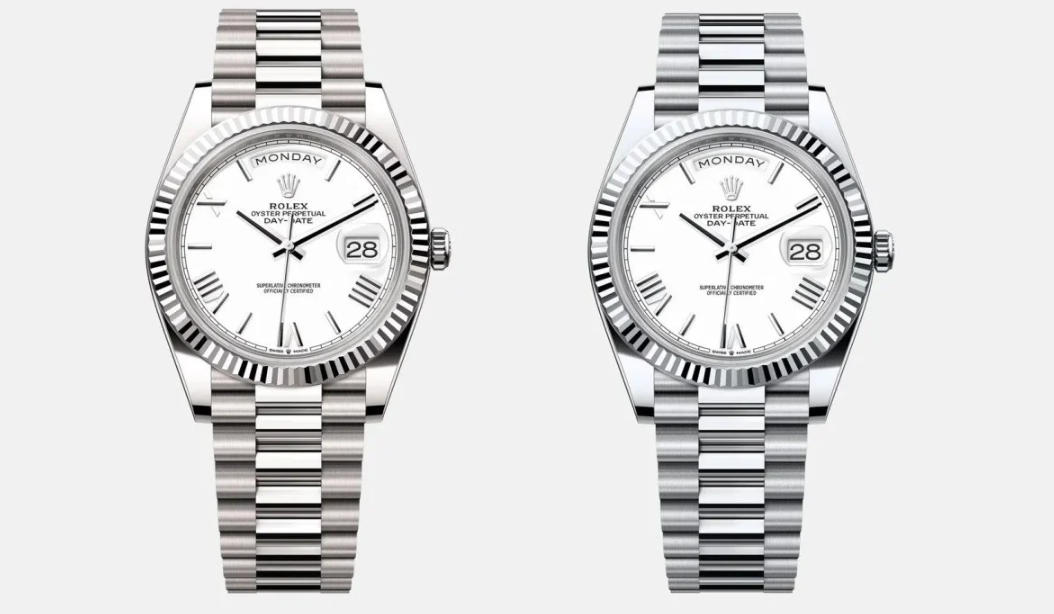
The 40mm top replica Rolex Day-Date watches in white gold, ref. 228239, retails for US$51,600 while the 40mm Rolex Day-Date in platinum, ref. 228236, has a retail price of US$68,800. The disparity extends to the secondary market, where both watches trade at roughly their retail price. In an efficient market, the gold watch would be worth more, since gold is worth far more than platinum. The fact that it’s selling for a significant discount makes it seem a clearly better value.
Don’t worry if you can’t tell the two watches apart. To the naked eye, especially when they’re not side by side, they’re functionally identical. The guts of the timepiece – the movement – is exactly the same in both; so is the dial, and the hands, and, well, everything except for the metal that the case and bracelet are made of. Both watches are heavy, silver-coloured and made of precious metal. Indeed, both watches have a stealth-wealth signalling function: to the untutored, they might look like steel, but Rolex aficionados know the Day-Date is made only in precious metal.
The price difference between the two watches doesn’t represent any kind of revealed preference in the broader jewellery market, where gold remains much more desirable than platinum. In watches, platinum does have its partisans: it’s pure, whereas white gold is an alloy that includes significant quantities of nickel, rhodium and other metals. To some, that makes it the precious-metal equivalent of white chocolate. And because the non-gold metals in white gold weigh less than gold or platinum, the pure-platinum watches is heavier. While many people value lightness in watches, others value heft. All that said, the platinum price premium appears mostly a sign of perfect copy Rolex watches astonishing ability to create desirability just by using scarcity and price signalling.
It’s also something of a historical artefact. Today, the platinum watch is desirable because it’s expensive. But back in the 1950s, when the best clone Rolex Day-Date watches was first released, the price disparity made a certain amount of sense. The price of gold was fixed at US$35 per ounce under the post-war Bretton Woods system, while the price of platinum was at least double that and sometimes much more. In the late 60s, platinum briefly traded for more than six times the price of gold, before the US moved off the gold standard in 1971 and the ratio plunged.
Platinum is still much rarer than gold – about 6 million ounces of it are mined per year, compared with 108 million ounces of gold – and it has developed a connotation of being higher status. (Think platinum credit cards, platinum records, platinum loyalty status.) But maybe it’s time for brands and consumers to update their priors: the idea that platinum is more valuable than gold hasn’t been reflected in the market for more than a decade. Today, platinum trades for about US$2,100 per ounce, while gold is well above US$4,300. As a result, even after taking into account that white gold is only 75 per cent gold, the actual value of the metal in the white gold Day-Date is substantially greater than the value of the platinum in its more expensive sibling.
In fact, gold is now so valuable, it can help support the value of a luxury watch like a Day-Date, which is produced in large enough quantities that it has a liquid secondary market. Data from Subdial shows the second-hand value of a Day-Date is generally very close to the retail price; it doesn’t move around much. As such, the 1:1 replica watches UK doubles as a way of buying a meaningful quantity of gold – about 5.3 troy ounces of the pure metal, worth some US$23,000 at current prices. That’s much more than the US$15,000 value of the 7 ounces of platinum in the more expensive version of the watch, even after a 135 per cent rise in the price of platinum over the past year.
To put it another way, when you buy the gold buy fake Rolex Day-Date watches, you’re paying US$23,000 for metal and US$28,600 for Rolex value, while the platinum version gets you US$15,000 of metal when you’re shelling out US$53,800 – roughly twice as much – for the otherwise identical Rolexness of the thing. To be sure, the platinum watches are rarer, so they have a slightly greater scarcity value, but they’re not exactly hard to find. A gold Rolex is an investment, a bit like gold itself but less volatile. A platinum Rolex is also an investment, but it’s one that trades at a much higher premium to fundamentals.
Platinum jewellery has been valued since Cartier started making jewels out of the metal in 1890 for its hardness and malleability: it can form light and delicate pieces that form a perfect backdrop for diamonds and other gemstones. Gold, by contrast, thanks to its distinctive colour, is always the main event – and people have been making jewellery out of it for thousands of years. Yellow gold is default luxury around the world; both white gold and platinum are always going to be niche tastes, and are almost unheard-of in many markets. Still, there are reasons why they exist.
“Some people just cannot stand the colour of gold,” says Vincent Gladu, the chief executive officer of Mené Inc., a company that makes investment jewellery out of pure gold and platinum. “They’ll be a platinum type of person.” But watch people are buying watches, not pure metal – and in terms of colour there’s almost no difference between platinum and white gold. The only real difference is that the amount of hard wealth that has been strapped onto your wrist is significantly greater with the cheaper AAA duplicate watches.